How Solar Panel Temperature Effect Impacts Open-Circuit Voltage, Short-Circuit Current
How Solar Panel Temperature Effect Impacts Open-Circuit Voltage, Short-Circuit Current, and Output Power
When the operating temperature of a solar panel rises, it significantly affects its electrical characteristics, primarily the open-circuit voltage (Voc) and short-circuit current (Isc). Understanding the solar panel temperature effect is crucial for optimizing photovoltaic (PV) system performance, especially in regions with high ambient temperatures.
1. Open-Circuit Voltage (Voc) Decreases
One of the most noticeable impacts of higher temperatures is the reduction in open-circuit voltage. Typically, for silicon-based solar cells, the Voc temperature coefficient is about -0.3% to -0.4% per degree Celsius. This means that for every 1°C rise in temperature, the Voc drops by about 2–3 mV per cell.
Why does this happen?
>> Bandgap Narrowing: As temperature increases, the thermal vibration of the semiconductor lattice intensifies, reducing the energy bandgap. This shrinkage decreases the energy difference between the valence band and the conduction band, weakening the built-in electric field in the PN junction.
>> Increase in Dark Current: Higher temperatures drastically increase the intrinsic carrier concentration, which causes the dark saturation current to rise exponentially. Since open-circuit voltage is inversely related to dark current, an increase in dark current lowers the Voc even further.
For example, under standard test conditions (STC) of 25°C, a silicon solar panel might have a Voc of 38V. If the temperature rises to 50°C, the Voc can drop to around 35V.
2. Short-Circuit Current (Isc) Slightly Increases
In contrast to Voc, the short-circuit current tends to increase slightly with temperature. The typical Isc temperature coefficient is about +0.04% to +0.1% per degree Celsius.
Why does Isc increase?
>> Enhanced Light Absorption: As the bandgap narrows, the semiconductor material can absorb more photons, generating more electron-hole pairs.
>> Thermal Excitation: Higher temperatures increase the thermal energy in the semiconductor, liberating more bound electrons to participate in conduction.
However, the impact of temperature on Isc is much smaller than that on Voc. For instance, if a solar module has an Isc of 5A at 25°C, it might only increase to about 5.1A at 50°C.
3. Combined Effect: Decreased Output Power
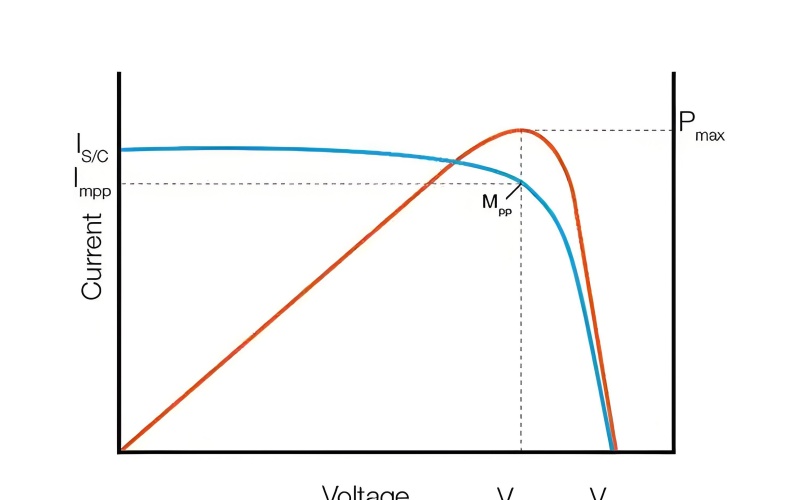
The overall power output (Pmax) of a solar panel is the product of voltage and current (P = Voc × Isc). While the Isc sees a slight boost, the much larger drop in Voc results in a net decrease in power output.
Typical data indicates that for every 1°C increase in temperature, the peak power output of a solar panel drops by about 0.35% to 0.45%. In hot climates where panel temperatures can reach 60°C or more, this can result in a power loss of 20% to 30% compared to STC.
4. Practical Considerations for Managing the Solar Panel Temperature Effect
>> Better Thermal Design: Effective heat dissipation through mounting systems, sufficient air circulation behind panels, and proper spacing can help reduce panel temperature and minimize efficiency loss.
>> Low Temperature Coefficient Modules: Choosing PV modules with lower temperature coefficients—such as PERC or HJT cells—can mitigate performance losses under high temperatures.
>> Regional Factors: In hot climates like deserts, high solar irradiance may not translate to higher output due to excessive heat losses. Therefore, thermal management is essential for maximizing actual energy yield.
Conclusion
In conclusion, the solar panel temperature effect is an unavoidable factor that directly impacts solar system efficiency. While rising temperatures slightly increase the short-circuit current, the much larger drop in open-circuit voltage leads to significant power losses. For system designers, installers, and users, understanding and managing this effect through proper module selection, smart installation design, and effective cooling measures is essential for maximizing long-term energy production and return on investment.