Analysis of Electroluminescence (EL) Defect Types in Photovoltaic Modules and Their Impact
Analysis of Electroluminescence (EL) Defect Types in Photovoltaic Modules and Their Impact
Introduction
Electroluminescence (EL) inspection is one of the key technologies for evaluating the quality of photovoltaic (PV) modules. By capturing near-infrared light emitted by solar cells under electrical bias, EL imaging enables a direct visualization of internal defects within the module. With advantages such as non-destructive nature, high sensitivity, and rapid inspection, EL testing has become an indispensable component of PV manufacturing and quality control processes. This article systematically introduces the common EL defect types found in PV modules, their characteristics, and the potential impact on module performance.
Common EL Defect Types and Characteristics
The table below summarizes the common types of EL-detected defects in PV modules, their imaging characteristics, physical causes, and potential impacts:
Defect Type | EL Image Characteristics | Physical Cause | Potential Impact |
Cracks | Linear or dendritic dark patterns | Mechanical or thermal stress | Power degradation, risk of hot spots |
Gridline Breaks | Local discontinuities in gridlines | Printing or sintering defects | Reduced current collection efficiency |
Black Core/Black Spots | Dark patches in central or local areas | Material impurities, contamination, or crystallographic defects | Local power loss |
Poor Soldering | Uneven brightness in interconnect areas | Inadequate soldering temperature or pressure | Increased contact resistance, power loss |
Breakage | Irregular dark zones or missing parts | Mechanical damage or improper handling | Increased risk of module failure |
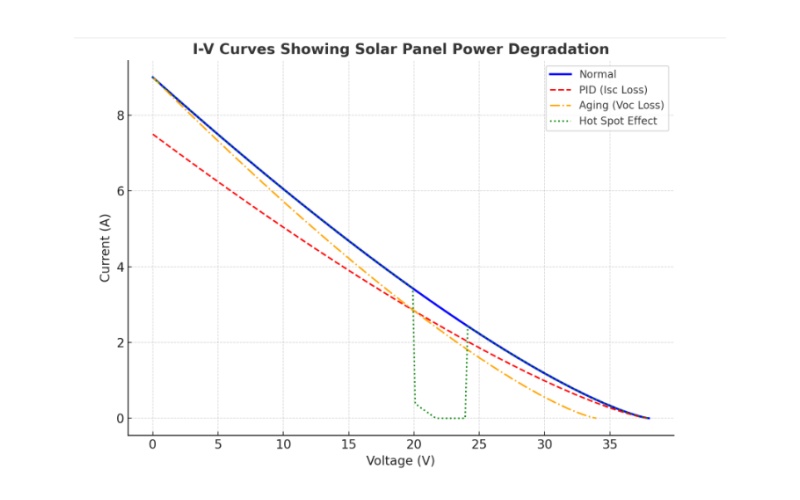
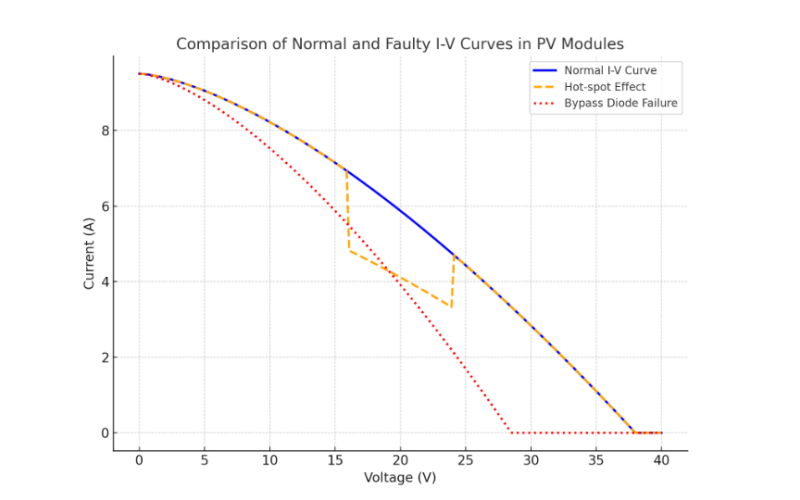
Hot Spots | Abnormally bright local areas | Current mismatch or local shading | Accelerated aging, potential fire hazard |
Mismatch | Significant brightness differences between cells | Mixed-use of cells with varying efficiencies | Overall power limited by the least efficient cell |
Edge Over-etching | Irregular dark areas along the edge | Improper etching process control | Reduced mechanical strength |
Firing Lines | Net-like or strip-shaped patterns | Non-uniform firing temperature | Possible impact on carrier collection |
Flux Residue | Local contamination zones | Incomplete post-soldering cleaning | Long-term risk of corrosion |
Detailed Analysis of Major Defect Types
1. Cracks
Cracks are among the most prevalent defects in PV modules and can be categorized into the following subtypes:
Linear Cracks: Straight cracks in a single direction
Dendritic Cracks: Complex, branched cracks extending in multiple directions
Microcracks: Tiny cracks not visible to the naked eye
According to the International Electrotechnical Commission (IEC) standards, the impact of cracks on module performance depends on their orientation relative to the main busbars. Cracks parallel to the main busbars have minimal impact, while those perpendicular cause significant power losses.
2. Gridline Breaks
Gridline breaks typically fall into these categories:
Main Busbar Breaks: Severely hinder current collection
Fine Gridline Breaks: Affect localized current transmission
Interconnection Point Breaks: Occur at gridline intersections
Studies indicate that when the total length of broken gridlines exceeds 5%, there is a marked drop in cell efficiency.
3. Black Core and Black Spot Defects
These defects arise from complex causes, including:
Material Defects: Impurities or dislocations in silicon ingots
Process Contamination: Metallic contamination during production
Crystallographic Defects: Dislocation clusters in monocrystalline silicon or grain boundary defects in multicrystalline silicon
Such defects typically increase local carrier recombination, reducing the open-circuit voltage and fill factor of the cells.
4. Soldering-Related Defects
Common soldering issues include:
Cold Soldering: Poor alloy formation between solder and cell electrodes
Over-soldering: Excessive heat damages electrodes or cells
Misaligned Busbars: Busbars are not aligned as per design specifications
Soldering defects significantly increase series resistance, making them a major contributor to power loss in PV modules.
Advantages of EL Testing Technology
High Sensitivity: Capable of detecting microcracks as small as 50 μm
Non-Destructive: Enables defect detection without disassembling the module
Quantitative Analysis: Defect severity can be quantified through image processing
Process Feedback: Facilitates rapid identification of issues in the production process
Inspection and Quality Control Recommendations
Inspection Frequency:
Production Line: 100% inspection is recommended
PV Plants: Inspect 5% of newly installed modules; perform sampling inspections on 2–3% annually during operation
Process Optimization Directions:
Reduce Mechanical Stress: Improve handling and lamination processes
Optimize Soldering Parameters: Adjust temperature profiles based on EL test results
Strengthen Incoming Material Inspection: Prevent defective cells from entering production
Data Management:
Build a Defect Database: Analyze patterns in defect distribution
Implement Statistical Process Control (SPC): Monitor key quality metrics continuously
Conclusion
EL inspection provides a powerful tool for assessing PV module quality. Through the systematic identification and analysis of various defects, it enables significant improvements in module reliability and power output. As PV technology continues to evolve, EL inspection is also advancing toward higher resolution, faster testing speeds, and more intelligent defect recognition. Manufacturers should fully leverage EL inspection results to continually optimize production processes and enhance module quality and reliability.